AI Transformation at b.telligent: Building a Sovereign AI Capability Across the Company
Kambria accompanied b.telligent from its first AI experiments to a structured, company-wide use of AI. The project brought together three elements of Kambria’s expertise: clear strategy, organization-wide enablement, and the implementation of sovereign AI infrastructure and practical use cases.

About the project
b.telligent is a consultancy for data, analytics, and AI. As part of the b.telligent group, Kambria has been supporting the company with its AI transformation initiative.
The goal: Build a long-term, company-wide capability to use AI strategically, sovereignly, and effectively. This required clear responsibilities, a controlled technical foundation, broad enablement, and a repeatable path that turns AI ideas into prioritized use cases, workflows, agents, and implementable software solutions.
The outcome: A sovereign AI workspace in b.telligent’s own Azure environment, foundational training for around 400 people, and an in-depth pioneer program for smaller groups that drive AI adoption across the organization. Through the "Use Case Factory" approach, Kambria has identified numerous opportunities and implemented use cases across all departments. Ongoing office hours and a planned roadshow support lasting adoption in day-to-day work.
The Challenge
b.telligent recognized early on that AI would change far more than its technology stack. The company needed to prepare not only for new tools, agents, and workflows, but also for the human and organizational implications: changing roles, new responsibilities, different decision-making processes, and closer collaboration across team boundaries.
To embed AI successfully, leadership, business functions, IT, and technical delivery needed to follow a shared approach. Responsibilities had to be clarified, new roles defined, governance structures established, and reliable paths created from the initial idea through to implementation.

How Should the Company React to AI?
b.telligent needed to determine how AI would change work across the organization. This included roles and responsibilities, decision-making processes, collaboration between teams, and the long-term operation of AI solutions.

How Do You Scale AI Without Losing Control?
The company wanted to provide many employees with access to AI while maintaining control over infrastructure, data, models, and complex solutions. It needed an operating model that enabled experimentation without creating uncontrolled technical or organizational risks.

How Do You Translate AI Ideas Into Useful Tools?
Ideas for using AI came throughout the teams and needed to be assessed and prioritized in a structured way. A clear process was required to determine what could be implemented internally and where specialized development was needed.
The Approach: One Transformation Program, From Strategy to Implementation
Align Strategy, Governance, and Ownership
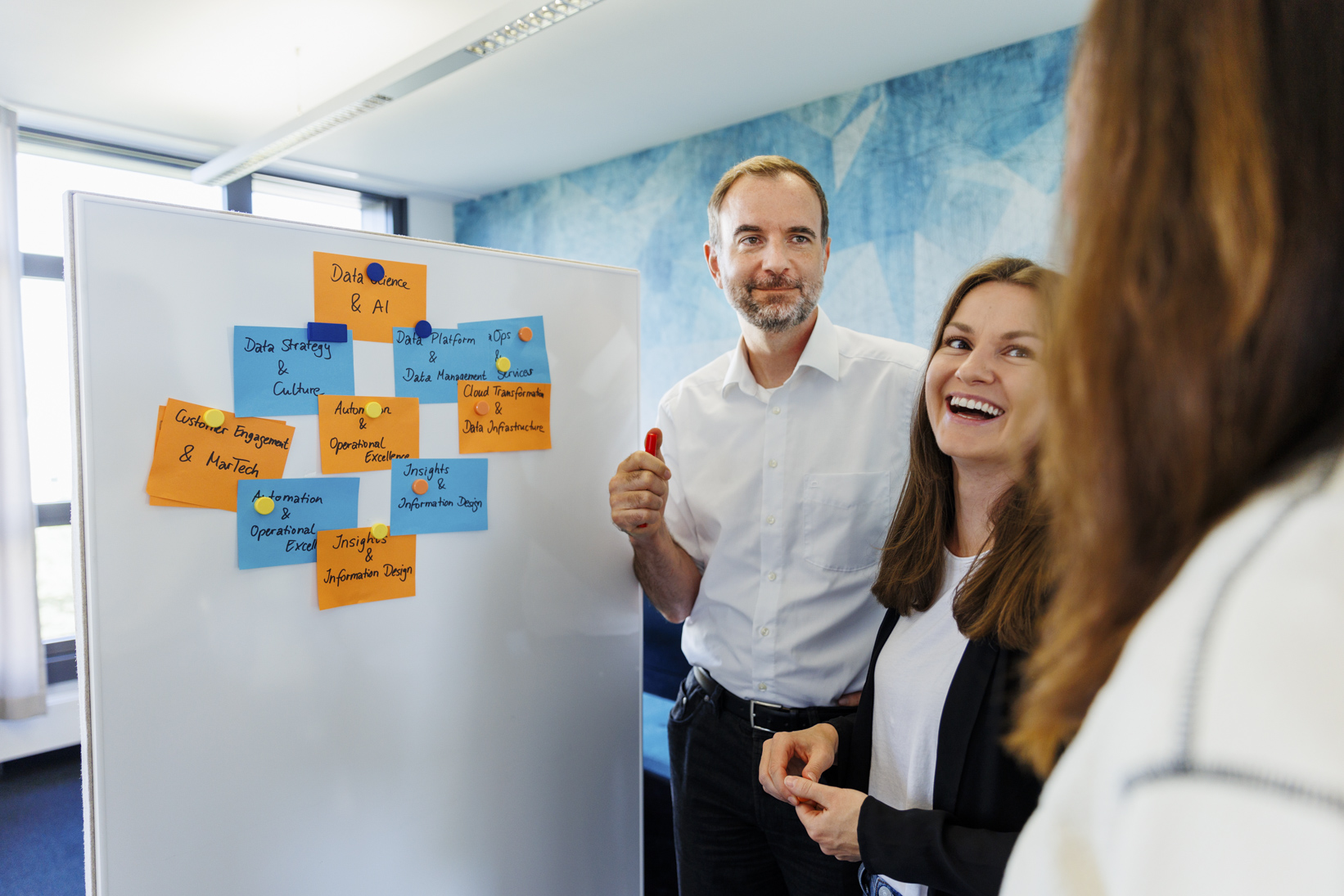
Before scaling tools or developing tailored solutions, Kambria and b.telligent established the foundations for long-term AI adoption. Via a series of workshops we identified the capabilities required to prioritize use cases and clarified responsibilities across leadership, business teams, IT, and technical specialists. We also defined the necessary governance principles to house secure and compliant AI use.
The result was a pragmatic roadmap and operating model designed to scale AI responsibly and deliver lasting value.

Launch a Sovereign AI Workspace and Train 400 Employees
Kambria introduced an AI workspace for around 400 users within b.telligent’s own Azure environment. The platform created a controlled foundation for broad AI adoption. At the same time, b.telligent retained control over hosting, identities, data processing, model access, and future operations.
In addition, approximately 400 users received foundational AI training. The focus was not only on using individual tools. Employees were expected to understand how to apply AI responsibly to real-world tasks and assess its value realistically. This created a shared baseline understanding across the organization.
Build Pioneer Teams for Assistants, Workflows, and Agents
Together with b.telligent, Kambria conducted our Pioneer Program. In the first twelve-week program, we enabled 15 predominantly non-technical employees to develop their own AI assistants and to identify use cases. In parallel, a technical group of around 8 people were enabled to build more complex workflows, agents, and automations using n8n. Complex solutions are managed by the specialized unit.
Use Case Factories and workshops prioritized automations with potential. This resulted in 3 AI-supported process redesigns in sales and marketing.

Project Results

Around 400 Employees Equipped to Use AI Responsibly
Providing access to the AI workplace and foundational training has enabled broad access to AI. At the same time, operating it within its own Azure environment gives b.telligent full control over the technical infrastructure.

Dedicated Teams for Both Everyday and Advanced AI Solutions
b.telligent has established an effective operating model for developing both simple AI assistants and complex, maintenance-intensive agents and workflows. The clear division of responsibilities between the technical unit and non-technical pioneer groups makes targeted use of employees’ respective skills.

A Repeatable Route from AI Opportunity to Implementation
The Use Case Factories created a structured pipeline for AI opportunities from different parts of the organization. Three fully AI-supported process redesigns have already been implemented and there is a clear path for introducing further automations.
“Working with Kambria has enabled us to embed AI strategically and practically within our company.”
“Together, we developed a clear direction, empowered our teams, and implemented initial solutions with tangible benefits.”

Our Learnings
AI Transformation Requires a New Operating Model
An AI strategy must consider more than technology choices and use cases. Organizations need clarity on who makes decisions, how teams collaborate, where technical responsibility sits, and how experiments become reliable solutions.
Leaders Must Make Time for AI Adoption
Employees can only experiment with AI on real tasks, recognize its limitations, and build confidence in their own judgment if dedicated time is allocated for it. Company leadership must clearly prioritize AI work and give it a fixed place alongside day-to-day business.
Advanced Workflows and Agents Need Dedicated Technical Owners
Chat-based assistants can often be created and shared by many employees independently. Workflows and agents require stronger technical ownership, as they can introduce additional risks related to security, data processing, maintenance, and quality. A specialized internal unit provides the right balance.



Ready to Take the Next Step?
Free intro call — 30 minutes
What you'll get out of it:
- Clarity on where you stand — Where are you on AI, and where are the biggest opportunities?
- The right fit, not a standard pitch — Strategy, implementation or enablement: together we'll find out what moves the needle most right now.
- Concrete next steps — A clear proposal on how to move forward with no strings attached.